This study challenges the Pallava script categorisation that has dominated Indonesian palaeographic studies for over a century. Through the decolonial analysis of three Sumatran inscriptions—Kĕdukan Bukit (682 CE), Kebon Kopi II (932 CE), and Ādityawarman (1347 CE)—we reveal how European colonial scholars systematically dismissed local innovations as errors. Using an archival archaeology methodology combining digital imaging with critique of colonial documentation, we demonstrate that variations categorised as inaccuracies were systematic innovations: phonological adaptations for Old Malay, multilingual diplomacy strategies, and autonomous liturgical registers. Epigraphic evidence shows that several palaeographic innovations originated in Sumatra, fundamentally challenging diffusionist models. We reposition Sumatra from passive periphery to active centre of palaeographic innovation, asserting Mignolo’s pluriversality to understand Southeast Asian intellectual history.
Key Words decolonial palaeography, Old Sumatran script, Old Malay, Kĕdukan Bukit, Ādityawarman inscriptions
Rereading Intellectual Autonomy in the Evolution of Old Sumatran Scripts: A Decolonial Analysis of Sumatran Palaeographic Evolution
(Published March 27, 2026)
Abstract
Introduction
Indonesian palaeographic studies have been dominated for over a century by conceptual frameworks created by European colonial scholars, particularly the Pallava script categorisation popularised by J. Ph. Vogel (1925). This terminological dominance reflects what A. Quijano (2000) calls the coloniality of knowledge—an epistemic system establishing European knowledge as the universal standard while invalidating other ways of knowing. A fundamental contradiction emerges with the Pallava script category, so central to Indonesian epigraphic studies, proving marginal in contemporary Indian palaeographic literature—exposing systematic bias in colonial scholarship.
Our research challenges this colonial framework by analysing Sumatran palaeographic evolution from the seventh to fourteenth centuries through a decolonial lens. We focus on three inscriptions representing key evolutionary stages: Kĕdukan Bukit (682 CE), first read by G. Cœdès (1930), provides the earliest evidence of Old Malay writing tradition. Kebon Kopi II (932 CE), published by F. D. K. Bosch (1941) and inscribed in Old Malay, records the political restoration in West Java. Ādityawarman (1347 CE), harshly analysed by H. Kern (1907) as nothing better than gibberish, represents aesthetic autonomy no longer dependent on external validation. These three inscriptions, spanning 665 years, enable the diachronic analysis of how Sumatran communities gradually developed the capacity not only to adapt but also to transform writing systems.
To reread these inscriptions beyond colonial frameworks, we have developed an archival archaeology methodology that integrates digital humanities technology with critical palaeographic analysis. Modern image processing enables us to see script details that were missed or overlooked by colonial-era cameras. By adjusting contrast and enhancing detail in old photographs, we can read aspects of stone carvings invisible to colonial scholars. Through this decolonial analysis, we aim to contribute to what W. D. Mignolo (2011) calls pluriversality as universal project—the recognition that various ways of knowing can coexist without hierarchical ranking.
To understand the colonial bias in palaeographic studies, we have adapted the decolonial frameworks developed by Latin American theorists. Quijano (2000) demonstrates that current hegemonic global power models presuppose coloniality. In Indonesian palaeography, this manifests through the systematic tendency to understand Southeast Asian script development under the assumption of unidirectional diffusion from India, automatically positioning local traditions as derivative. Colonial readings characteristically assume unidirectional diffusion, interpret local variation as error, deny innovative capacity, control terminology, and impose temporal linearity. Our decolonial reading recognises local intellectual agency, interprets variation as deliberate innovation, analyses multi-directional exchange, uses contextually grounded terminology, and acknowledges multiple temporalities.
We have specifically identified documentation by influential European scholars shaping Indonesian palaeographic frameworks. Kern (1907) called Ādityawarman’s language ‘impossible Sanskrit... no better than babble’ despite acknowledging its metric perfection—a paradox exposing colonial methodology. When technical evidence contradicted normative expectations, scholars disqualified texts rather than revise assumptions. Cœdès (1930) popularised Pallava terminology rarely found in Indian palaeographic literature. Vogel (1925) established the unidirectional India-Southeast Asia paradigm. Bosch (1941) interpreted the usage of Old Malay as leaving no other conclusion than subordination, rejecting alternative interpretations, such as equal diplomacy or strategic alliance.
Archival archaeology as a methodology, developed by A. L. Stoler (2009), operates in our research on three interrelated levels. First, the material level focuses on the detailed visual analysis of inscriptions using digital technology to reveal previously invisible evidence. Second, the discursive level systematically deconstructs colonial categorisation and interpretation. Third, the epistemic level critically reflects on how we produce knowledge about the past. The application of W. Benjamin’s (1969) method of reading against the grain to Cœdès’s interpretation reveals systematic bias. Cœdès (1930) interpreted the word sāmwau as a place name, while Poerbatjaraka (1952) later demonstrated that the word meant boat. This error reflects colonial assumption: when encountering unfamiliar words, the first interpretation is always foreign place names, not legitimate Old Malay vocabulary.
As Indonesian scholars in a contemporary institutional context, our interpretations are inevitably shaped by situated historical and ideological experiences. However, as Quijano (2000) explains, Eurocentric perspectives operate ‘as (a) mirror that distorts what it reflects’. Colonial scholars also worked from situated positions, yet they disguised their positional limitations behind the rhetoric of scientific objectivity—what Mignolo (2011) identified as an integral part of colonial epistemology. To address concerns about subjective bias, we have adapted systematic transparency regarding our methodological choices and used digital technology to allow for independent verification. The conclusions we have presented are tentative and open to revision, acknowledging that interpretive categories are never neutral.
The trajectory from strategic adaptation towards complete aesthetic autonomy stretches across seven centuries of Sumatran palaeographic development. The Kĕdukan Bukit inscription reveals, through digital enhancement, how systematic phonological innovations challenge assumptions about passive borrowing. Kebon Kopi II demonstrates cultural diplomacy through multilingual strategies. Ādityawarman shows aesthetic autonomy no longer dependent on external validation. Chronological evidence shows that several palaeographic innovations originated in Sumatra, fundamentally challenging diffusionist assumptions.
Kědukan Bukit: Strategic Adaptation (682 CE)
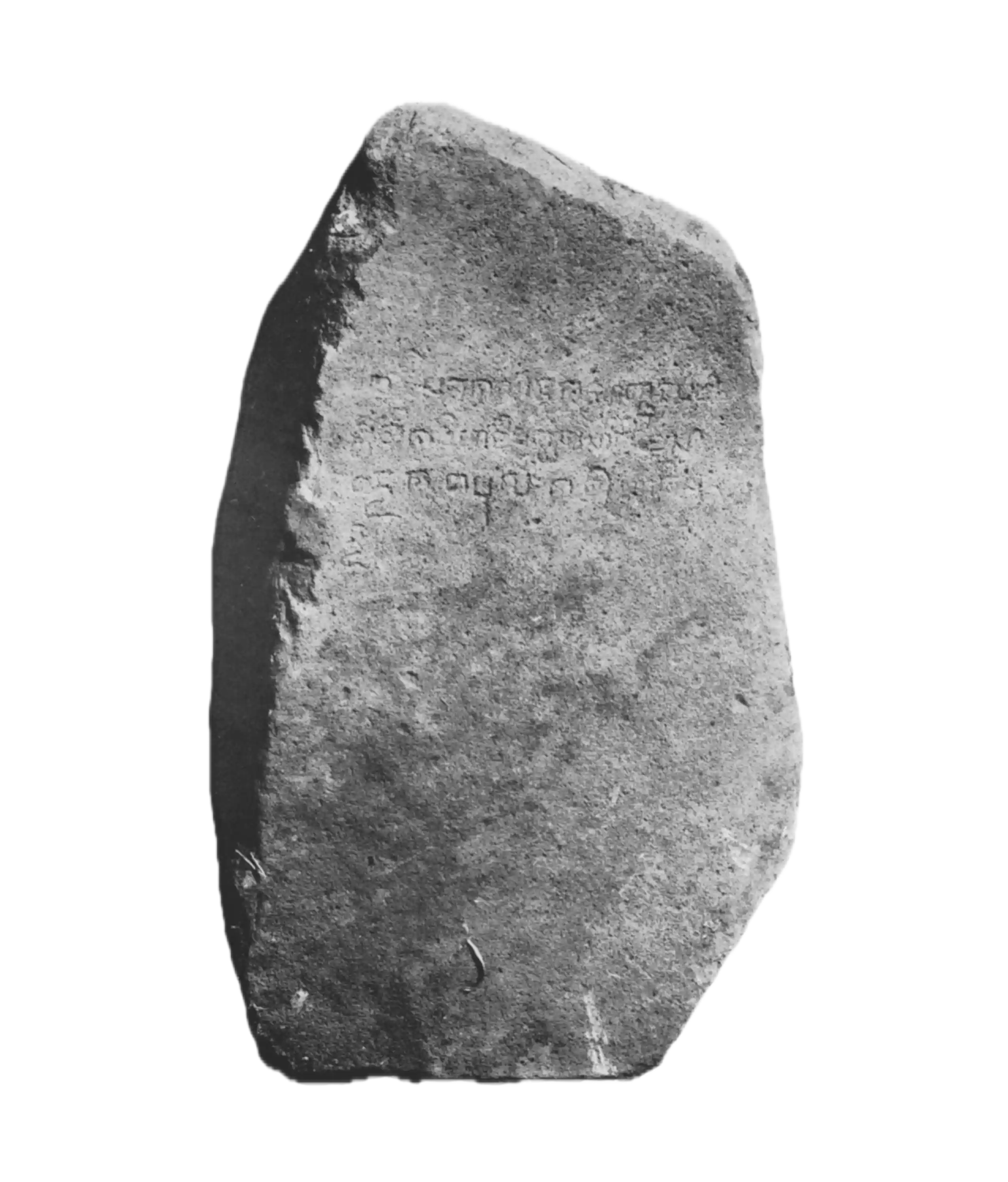
The Kĕdukan Bukit inscription, discovered by M. Batenburg on 29 November 1920 near Palembang, South Sumatra, offers the earliest evidence of Old Malay writing tradition. Dating from 604 Śaka or 682 CE, this inscription became the departure point for Indonesian palaeographic analysis since Cœdès published his monumental study in 1930. Within the dominant diffusionist framework, Cœdès interpreted it as evidence of Pallava script transmission from South India, with Sumatran communities as passive recipients. However, Cœdès (1930: 30) himself noted documentation limitations: the rounded shape of the stone made obtaining a good estampage (rubbing) very difficult, and the existing estampages were ‘impropre à la reproduction’ (unsuitable for reproduction) (Figure 1). These limitations created conditions in which colonial interpretation became dominant without adequate independent verification.
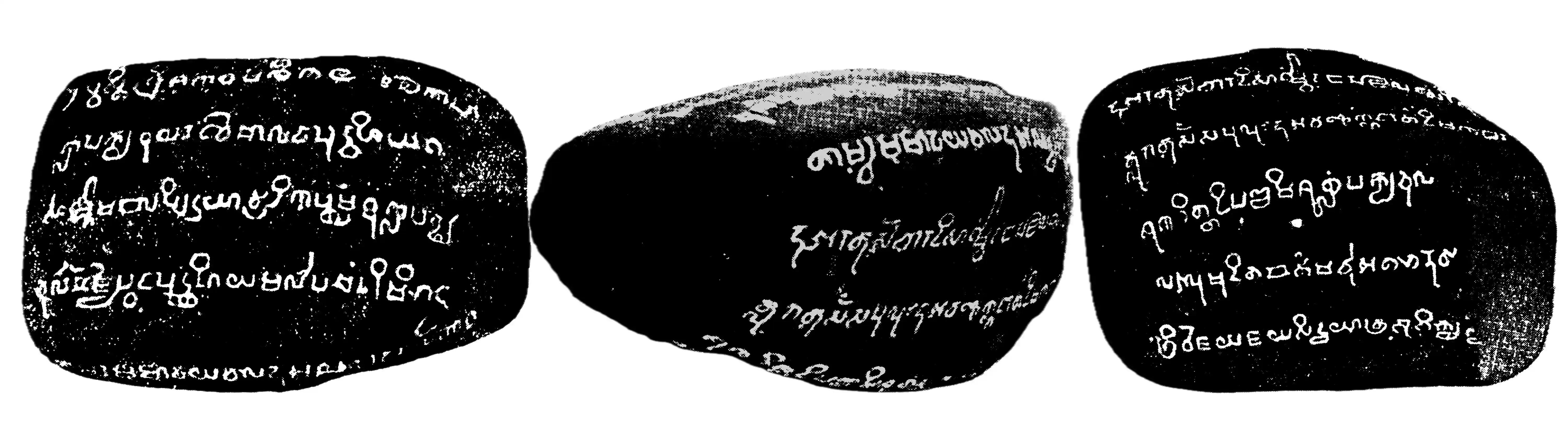
Critical analysis reveals systematic methodological bias in how Cœdès interpreted Old Malay. Aside from the word sāmwau (boat), Cœdès (1930) also encountered the phrase mināṅa tāmwan in line four. Cœdès (1930) interpreted Mināṅa Tāmwan as a single place name, even associating it with a location in the Mekong Delta, South Vietnam—very far from the Sumatran context. This interpretation reflects the tendency to search for exotic geographical references rather than considering that these words had lexical meaning in Old Malay. Poerbatjaraka (1952) later showed the possible connection of mināṅa with Minangkabau through the phonetic evolution of Minanga Tamwan → Minang Kabau, while Boechari (1986) proposed that tāmwan was not part of a place name, but a conjunction meaning while, at the same time, also. S. Muljana (2006) and O. W. Wolters (1967) offered alternative locations in Sumatra that were far more geographically plausible.
The same bias pattern emerges in Cœdès’s reading of the word mukha in line seven. Cœdès (1930) read this phrase as mukha jap or mata jap, assuming that jap was an unknown place name. However, the word mukha in Sanskrit and Old Malay means estuary or river mouth—a geographical concept highly relevant in the context of Śrīwijaya’s maritime and riverine expeditions. J. G. de Casparis (1956) later suggested the reading of mukha upang, connecting it with Upang, a village on the banks of the Musi River. Boechari (1979) briefly proposed mukha upaṃ, but later withdrew the proposal (Boechari 1986). The problematic aspect here is not the reading uncertainty—the inscription is indeed worn—but Cœdès’s default assumption that the unreadable parts must be foreign place names.
These word examples reveal a consistent epistemological pattern in Cœdès’s approach to Old Malay texts. When confronted with unfamiliar words, the first hypothesis was always a foreign place name or loanword from another language, not the possibility that seventh-century Old Malay had its own rich and complex vocabulary. This pattern reflects a deeper colonial assumption: the inability to acknowledge that Old Malay possessed the full linguistic capacity to express complex concepts without depending on external loanwords or references to foreign geography. Each time colonial scholars assumed unfamiliar words must have come from outside, they systematically denied the possibility of local innovation and the lexical richness of Old Malay.
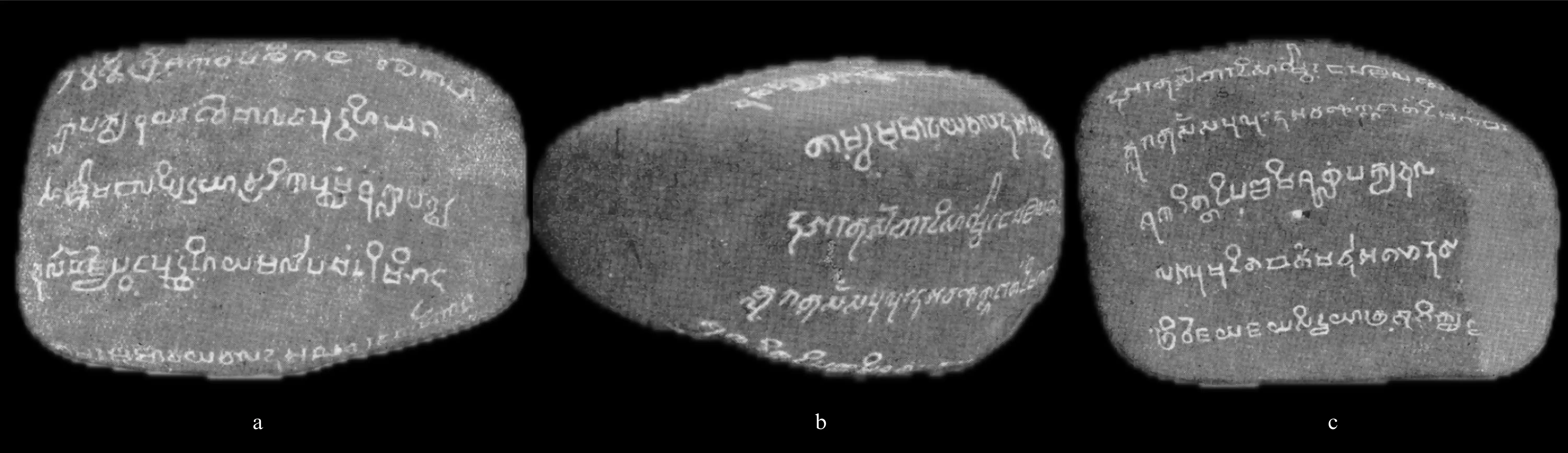
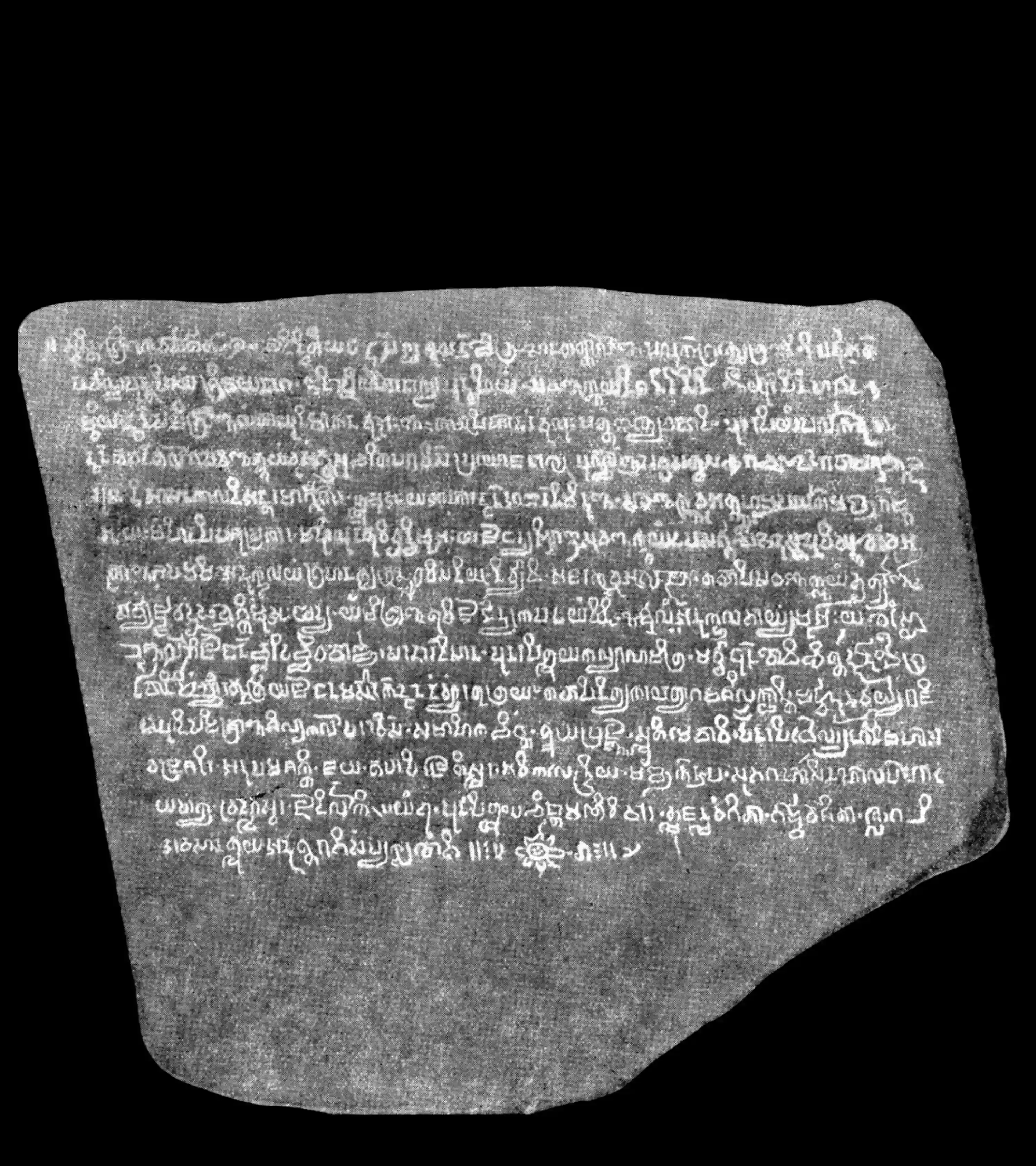
Digital analysis yields striking findings. Figure 2 reveals a systematic distribution of anusvāra marks—small circles above certain characters. For readers unfamiliar with palaeography: anusvāra (a diacritic mark in South and Southeast Asian scripts or aksara) represents nasal sounds. In Sanskrit, anusvāra typically represents the bilabial nasal /ṃ/ (like m in kampung, village).
The systematic analysis of Kĕdukan Bukit reveals a striking pattern. This ten-line inscription contains nine distinctive anusvāra marks, all appearing exclusively in Old Malay words to represent the velar nasal /ŋ/ (written ng): hiyang (sacred, lines 2 and 4), yang (which, line 5), and dātang (come, lines 7 and 9). Crucially, no single anusvāra represents the Sanskrit bilabial nasal /ṃ/—a phoneme expected if writers had merely followed South Indian Pallava conventions. This exclusive deployment of anusvāra for Old Malay phonology, compared with the mixed-function occurrences typically observed in South Indian Pallava inscriptions of similar length, reveals deliberate phonological innovation rather than passive script adoption.
This systematic pattern constitutes evidence of linguistic engineering. Colonial scholars such as Cœdès (1930) observed this phenomenon but fundamentally misunderstood its significance, noting that Old Malay words with anusvāra ‘correspond with guttural pronunciation’ while treating this as inconsistency or deviation from Sanskrit norm. What Cœdès categorised as error is deliberate innovation: seventh-century Sumatran writers systematically transformed the function of the anusvāra diacritic mark—which in Sanskrit represents the bilabial nasal /ṃ/—to represent the Old Malay velar nasal /ŋ/, a phoneme absent in classical Sanskrit but essential to Old Malay phonology. The complete absence of the Sanskrit-style /ṃ/ proves that writers were not passively copying an Indian system; they actively redesigned it to serve local linguistic needs.
The Kĕdukan Bukit inscription tells a complex story: a ruler’s magical journey to obtain supernatural power (siddhayātra, ritual journey), followed by a large military procession—twenty thousand troops, two hundred followers travelling by boat, and one thousand three hundred twelve followers travelling by land—towards the establishment of Śrīwijaya wanua (polity). The ability to tell this story in Old Malay proves that seventh-century Sumatra possessed far greater linguistic position than colonial scholars had assumed. The text blends vocabulary: using Indian ritual terms (siddhayātra) alongside Old Malay military terms (wala dualaksa = twenty thousand troops), expressing emotions through words (sukhacitta = joyful heart, mudita = happy) that have no direct Sanskrit equivalents, and composing narrative with clear time markers (from pratipada śuklapakṣa wulan waiśākha to pañcamī śuklapakṣa). If seventh-century Sumatrans were merely passively copying Indian culture, they would not be capable of writing such a complex bilingual narrative.
Analysis of Kĕdukan Bukit reveals what Mignolo (2011) calls epistemic disobedience—the refusal to accept imported categories as the inevitable standards. When Cœdès interpreted this inscription within the Pallava transmission framework, he ignored evidence he himself had documented: the capacity to represent a complex theological-political narrative in Old Malay, use of military and emotional terminology, and ability to integrate Indian ritual concepts into the Old Malay linguistic structure without losing coherence. The Kĕdukan Bukit inscription thus represents not passive transmission, but strategic adaptation marking the beginning of the trajectory towards autonomy.
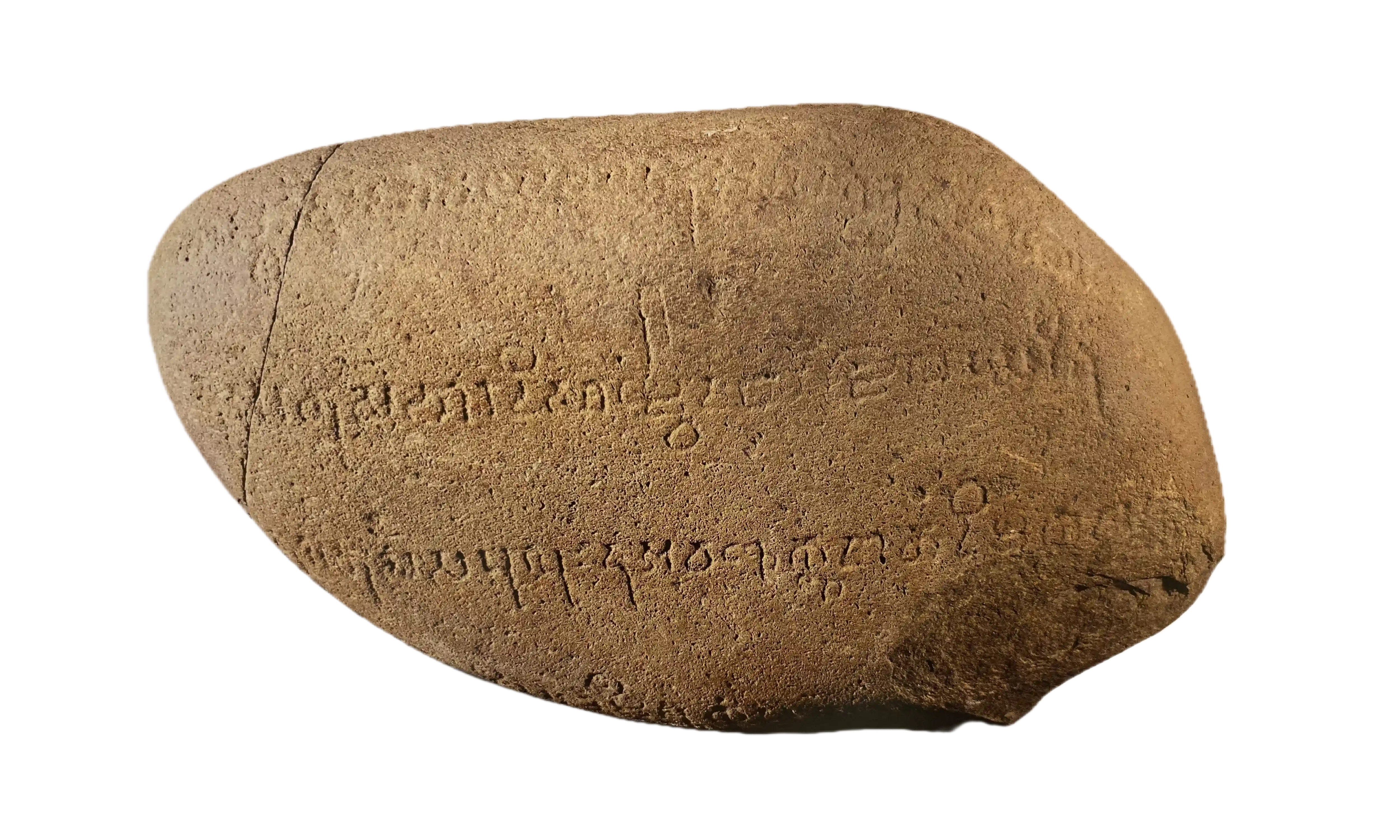
The capacity for phonological innovation evidenced in Kĕdukan Bukit extends to aesthetic dimensions two years later. The seventh-century Talang Tuwo inscription (684 CE), found west of Palembang, further proves this writing capacity. Its fourteen lines comprise a Buddhist vow (pranidhāna) by Jayanāśa, Śrīwijaya’s ruler, regarding the construction of a Śrīkṣetra garden. What makes Talang Tuwo interesting is its deployment of highly technical Mahāyāna Buddhist terminology—including vajraśarīra (vajra body) and anuttarābhisamyaksambodhi (highest perfect enlightenment)—showing deep understanding of Mahāyāna doctrine. This theological precision challenges colonial assumptions about derivative Southeast Asian Buddhism. The inscription survives in multiple documentary records from different periods (Figures 4-5).
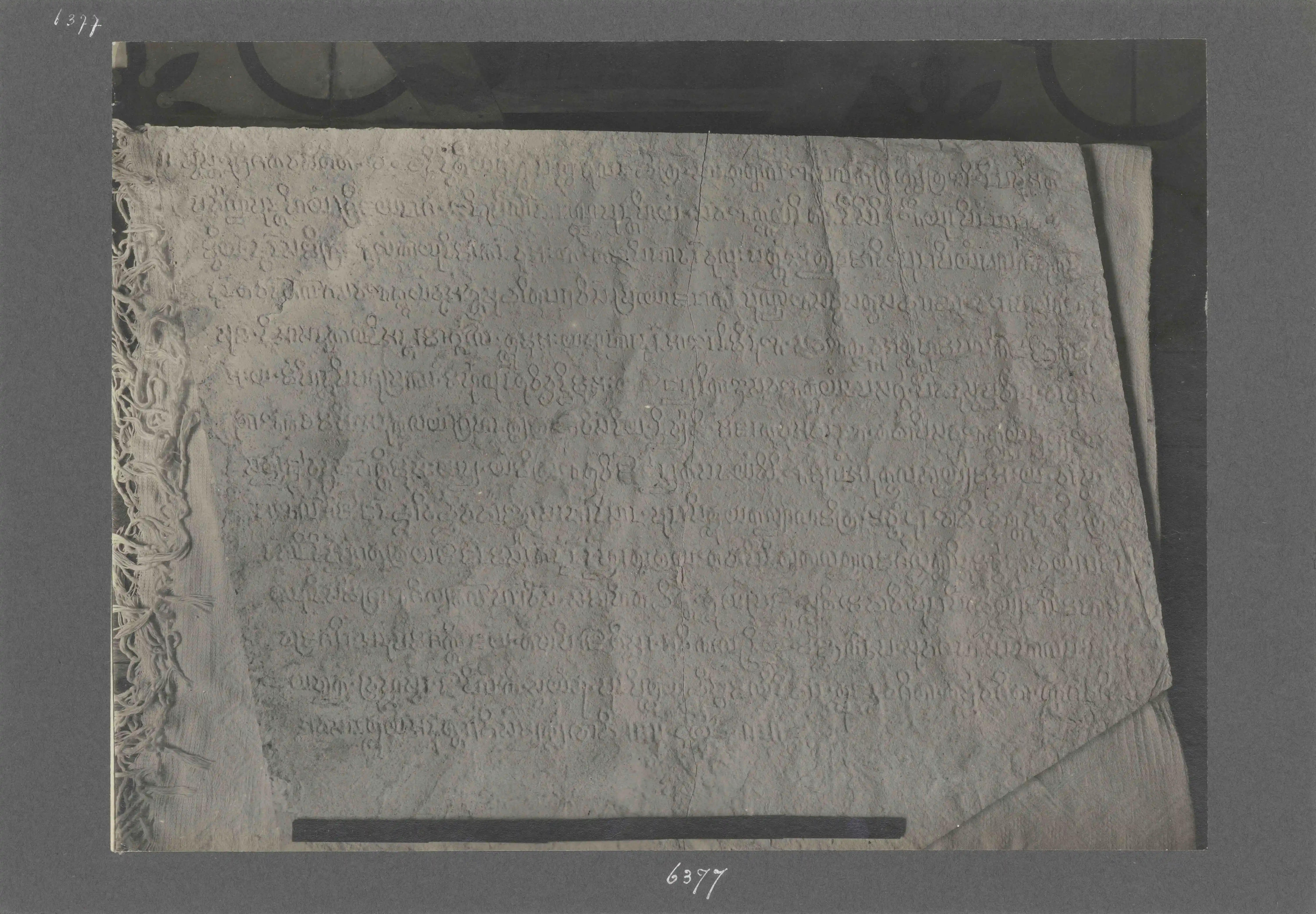
Palaeographically, the digital enhancement of Figure 3 reveals a consistent application of what we call the uniform height principle. All characters maintain an identical height, as if positioned between an invisible baseline (the line on which characters rest) and cap line (the upper boundary limiting character height). This consistency extends to hundreds of characters, even in complex ligatures combining multiple base forms (like the conjunction sty in line 7). Achieving such uniformity requires either temporary guides during carving (which leave no archaeological traces) or professional mastery of the writing technique. This principle shows more than aesthetic choice—it reflects a mature consideration of how written text functions in public space, facilitating reading from a considerable distance. This combination of theological advancement and palaeographic innovation shows that Sumatran innovations operated simultaneously across linguistic, religious, and aesthetic dimensions.
The strategic adaptation demonstrated by Kĕdukan Bukit—where seventh-century Sumatran communities deliberately chose writing to commemorate political power—represents the first phase of the seven-century evolutionary trajectory. Two and a half centuries later, the Kebon Kopi II inscription (932 CE) shows how the Sumatran palaeographic tradition evolved from internal innovation towards external diplomacy: the ability to navigate multiple cultural frameworks simultaneously for political purposes.
Kebon Kopi II: Cultural Diplomacy (932 CE)
To perceive the diplomatic nature of the Kebon Kopi II inscription, we must first understand the long historical context. The Kota Kapur inscription from Śrīwijaya, dated 686 CE, records Śrīwijaya’s desire to conquer bhūmijāwa—a region some researchers interpret as Tārumanāgara (Cœdès 1930; Moens 1937; Poerbatjaraka 1952). The text states: ‘śrīwijaya, kaliwat manāpik yaṃ bhūmijāwa tida bhakti ka śrīwijaya’ or ‘Śrīwijaya very much strives to conquer Bhūmijāwa which does not submit to Śrīwijaya’ (Cœdès 1930; Djafar 2014). The word manāpik, meaning to pursue or strive to conquer, is language of active subjugation. Chinese records from the Tang Dynasty provide supporting evidence. Envoys from Tārūma or To-lo-mo were recorded arriving in China between 666 and 669 CE, but no more missions were recorded after that (Moens 1937; Djafar 2014). This diplomatic silence suggests Tārumanāgara likely lost political sovereignty after the Śrīwijaya invasion in the late seventh century. Thus, when the Kebon Kopi II inscription was carved in 932 CE—nearly two and a half centuries after the Śrīwijaya invasion—it did not record the beginning of subordination, but the end of a long period of domination.
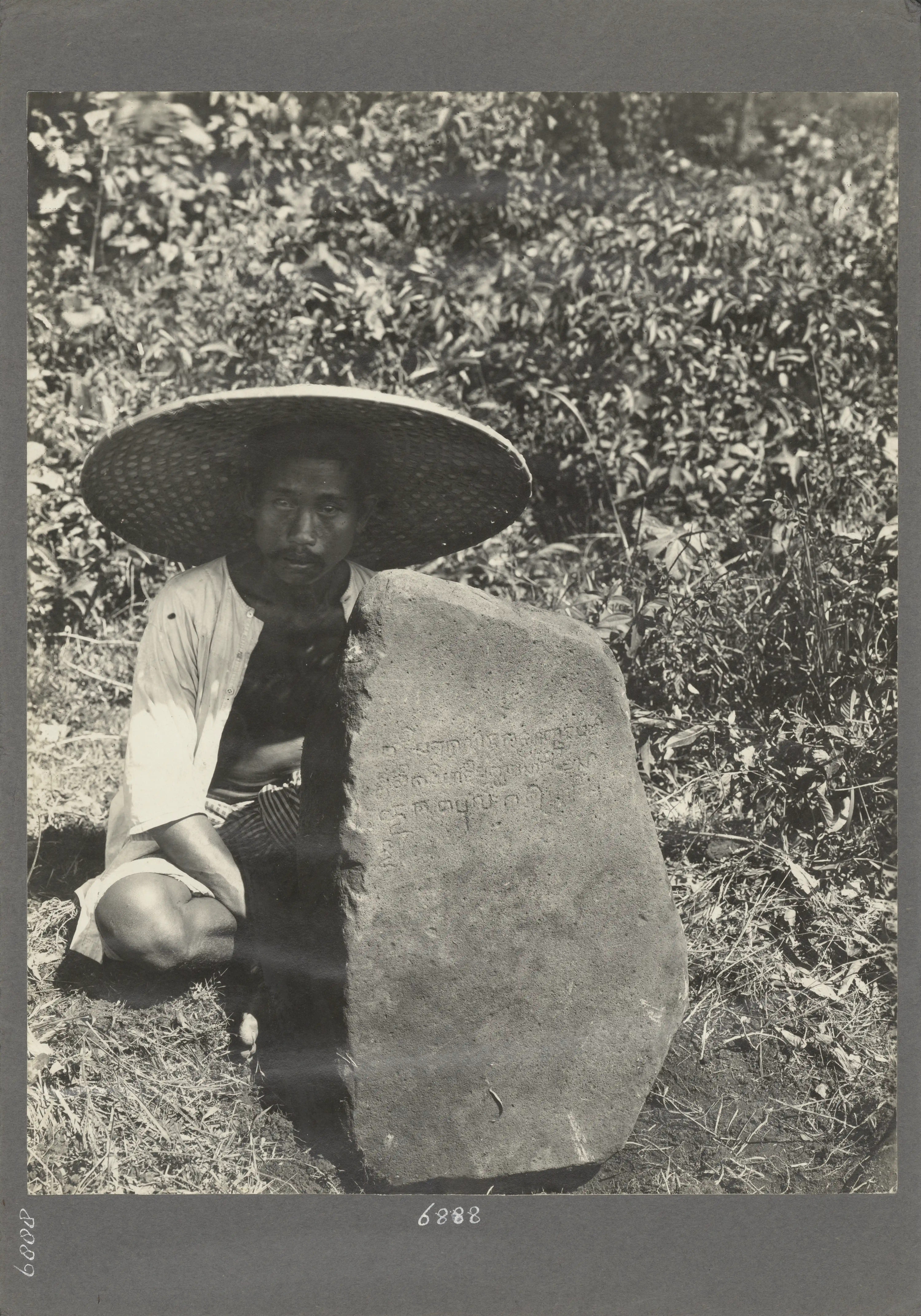
The Kebon Kopi II inscription was found near Kampung Muara, Ciaruteun, adjacent to the Kebon Kopi I inscription from the Tārumanāgara period, found near Buitenzorg (now known as Bogor in West Java). This inscription is now lost, so research depends on photographic documentation made by the Oudheidkundige Dienst with the number OD-6888 (Figure 6). The Old Malay text reads:
(1) °ini sabdakalānda rākryan juru paŋā
(2) mbat=i kawi hāji pañca pasāgi marsā
(3) ndeśa ba(r)puliḥkan hāji su
(4) nda //
Bosch translated this text as: ‘This is (a) memorial command from Rākryan Juru Paŋambat issued in year 854 or 932 CE ordering that (a) Sundanese king be restored to (a) previous position’ (Figure 7). The date is noted in the Old Javanese candrasaṅkala system, in which numbers are represented through words with numerical meaning. The formula kawi hāji pañca pasāgi represents 854 Śaka or 932 CE according to Bosch's (1941) interpretation.
When Bosch first published this inscription in 1941, he concluded that the Old Malay usage ‘laat geen andere conclusie toe’ or ‘leaves no other conclusion’: ‘dat Soenda in het midden der 10e eeuw in cultureel en waarschijnlijk ook in politiek opzicht aan de macht van het Sumatraansche rijk Çriwijaya is onderworpen geweest’ or ‘that Sunda in (the) mid-tenth century CE in cultural aspect and probably also political aspect was subordinated to Śrīwijaya power centred in Sumatra’ (Bosch 1941). Bosch’s interpretation reflects the hierarchical bias typical of colonial scholarship. The phrase leaves no other conclusion exemplifies the rejection of alternative interpretations. The term onderworpen or subordination leaves no room for other possibilities: equal-status diplomacy, strategic alliance, or multilingualism as a political strategy.
However, this interpretation insufficiently considers two crucial matters. The first is the historical context that this inscription was created not at beginning of the Śrīwijaya expansion but 246 years after the initial conquest. The second is the material evidence embedded in the inscription itself. When we situate this inscription in a longer historical span—as a document marking the end rather than continuation of a 246-year occupation—a very different interpretation emerges.
Critical analysis reveals a dimension missed by Bosch’s interpretation: the use of the Old Javanese dating system or candrasaṅkala in the Old Malay-dominant text. The crucial question Bosch did not answer is, why does a document marking the end of 246 years of Śrīwijaya domination use this complex Old Javanese dating system? If this represented continuing domination, as Bosch claimed, we would expect complete imposition—the entire inscription in Old Malay with the Śrīwijaya chronological system. However, the converse occurred: the main language remained Old Malay, indicating Śrīwijaya still had the authority to conduct restoration, while the chronological system adopted the Old Javanese convention, indicating full acknowledgement of the local tradition’s legitimacy to be restored.
This is evidence of a bilateral negotiation to end domination. Both sides acknowledged each other’s traditions through carefully negotiated palaeographic, linguistic, and chronological choices. The Old Javanese chronological system is not incidental decoration but a formal acknowledgement that the temporal framework governing this restoration belongs to the Javanese-Sundanese tradition, not that of the withdrawing Śrīwijaya rulers.
The word barpuliḥkan or ‘restore’ represents the strongest linguistic evidence that this inscription concerns ending the occupation, not perpetuating it. Linguistically, barpuliḥkan from the root word puliḥ, meaning to heal, restore, return, implies the restoration of status quo ante or acknowledgement of a previously legitimate right that was disrupted and is now restored (Djafar 2014). Consider the difference: ‘I give you position’, which is a gift from a superior, affirming continuing hierarchy, versus ‘I restore your position’, which is an acknowledgement of prior right, affirming independent legitimacy. The second formulation acknowledges that the position was a pre-existing right, a right disrupted by the Śrīwijaya invasion in 686 CE and now restored in 932 CE after 246 years. This is not language of continuing domination but that of occupation termination through restorative justice.
The restorative grammar of barpuliḥkan sharply contrasts with the language of the previous Kota Kapur inscription, which used manāpik, meaning to pursue, strive to conquer, i.e., language of active subjugation. The shift from conquest vocabulary to restorative vocabulary over 246 years marks a fundamental transformation in political relations, from unilateral coercion to negotiated restoration.
The historical context Bosch (1941) proposed strengthens this new interpretation, although Bosch himself failed to see its implications. In 929 CE, the Javanese king Mpu Sindok moved power to East Java and severed ties with Central Java, creating a regional power vacuum. In this context, Śrīwijaya’s decision to restore a Sundanese King in 932 CE—only three years after Mpu Sindok’s relocation—can be read not as the imposition of new power but as a strategic withdrawal from a territory dominated for 246 years.
Why did Śrīwijaya choose this moment to end domination? With the power vacuum created by Mpu Sindok’s withdrawal, Śrīwijaya needed a legitimate local ally to fill the void—not a unilaterally appointed official, as had occurred during the 246 years of domination, but a local ruler with independent legitimacy acknowledged through formal restoration. Conversely, the Sundanese King gained from Śrīwijaya a formal acknowledgement of legitimacy and diplomatic protection against possible East Javanese expansion under Mpu Sindok. This is bilateral negotiation benefiting both parties to end a long domination.
Timing is crucial. If Śrīwijaya had intended to maintain control, the 929 CE power vacuum would have provided the ideal opportunity for direct annexation or the installation of a dependent governor. However, Śrīwijaya chose the formal restoration of local sovereignty, showing that the primary objective was not continuing subordination but the establishment of sustainable diplomatic relations to protect mutual interests in the changing regional order.
Analysis of Kebon Kopi II reveals a practice Mignolo (2011) calls border thinking—an epistemology emerging from places and bodies left behind by lines of power. The hybrid strategy evidenced in this inscription proves the capacity to operate simultaneously in two or more cultural frameworks to negotiate the end of domination. The combination of Old Malay with an Old Javanese chronological system and the restorative linguistic barpuliḥkan creates a layered diplomatic text: at the linguistic level (Old Malay), at the temporal level (Old Javanese candrasaṅkala), and at the semantic level (restorative not conferral).
This does not arise from confusion or continuing subordination, but as a deliberate diplomatic strategy. Both sides acknowledge each other’s traditions to create a framework that allowed dignified Śrīwijaya withdrawal while restoring local legitimacy. The inscription simultaneously indicates through the Old Malay language that Śrīwijaya still has the authority to restore power, while acknowledging through the Old Javanese chronological system and restorative linguistics the full legitimacy of the Sundanese-Javanese cultural tradition.
When Bosch (1941) interpreted the use of Old Malay as evidence of continuing subordination, he ignored the 246-year historical context and failed to acknowledge that multilingualism and cultural brokerage in this context had manifested negotiation to end domination, not perpetuate it. Kebon Kopi II thus represents the second phase in the trajectory towards autonomy: cultural diplomacy to end foreign domination through bilateral legitimacy negotiation. Local communities not only adapted external elements but also actively negotiated the restoration of their sovereignty through deliberate linguistic, palaeographic, and chronological choices.
Before examining the final stage of aesthetic autonomy in the Ādityawarman inscription (1347 CE), it is important to note an intermediate development. The cultural brokerage demonstrated in the tenth-century Kebon Kopi II—the strategic deployment of hybrid linguistic and palaeographic forms to navigate between Śrīwijaya and Sundanese (West Javanese) traditions with regard to East Java—represents the middle stage in Sumatran palaeographic evolution. This diplomatic accommodation strategy, although showing intellectual autonomy, still operates within the framework of negotiation with external centres. The assertion that would emerge in thirteenth-century inscriptions like Dharmmāśraya, calling Sumatra swarṇṇabhūmi (land of gold) with equal status to Java, marks an important shift from diplomatic accommodation towards cultural confidence. The Dharmmāśraya inscription (1286 CE), carved around the Amoghapāśa statue pedestal, uses the phrase bhūmijāwa ka swarṇṇabhūmi (from the land of Java to the land of gold), strategically deploying Old Malay terms, like swarṇṇabhūmi, rajaputrī, and mahārāja, alongside Sanskrit terminology to create a deliberate hybrid register that affirms local authority while engaging in pan-regional political discourse. However, even this assertion still operates within external legitimacy frameworks, positioning Sumatra within the existing regional hierarchy while claiming equal status. The final stage of this evolutionary trajectory would arrive in the fourteenth century with the Ādityawarman inscription, which no longer sought validation from external centres but created a fully autonomous palaeographic and liturgical tradition.
Ādityawarman: Aesthetic Autonomy (1347 CE)
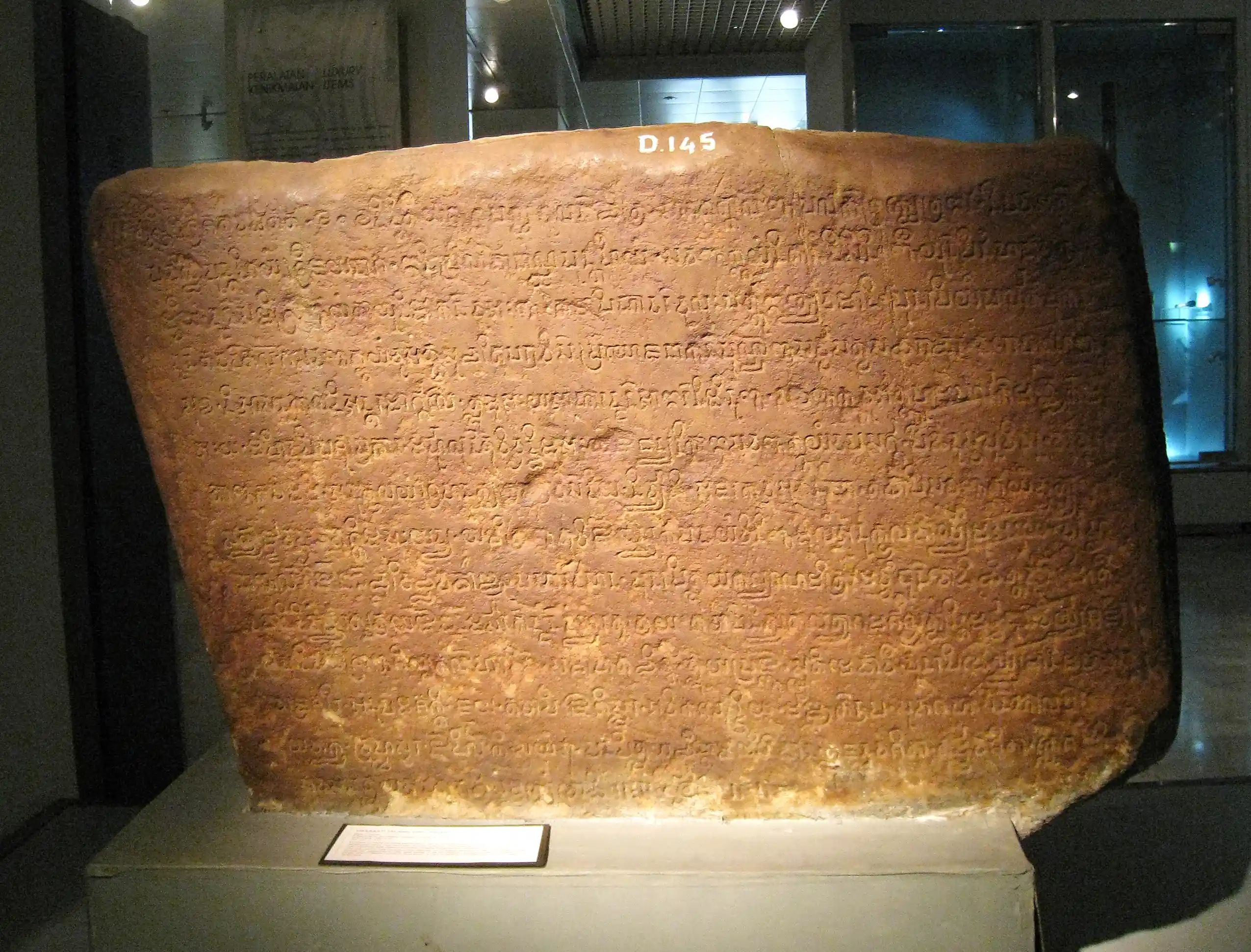
The Ādityawarman inscription, carved on the back of the Amoghapāśa statue and dated 1269 Śaka or 1347 CE (Figure 8), represents the culmination of an intellectual journey unfolding over nearly seven centuries: the moment Sumatran palaeographic tradition achieved full autonomy and decisively declared independence from external validation. Kern (1907) offered a harsh assessment of the language: the inscription language is onmogelijk Sanskrit (impossible Sanskrit) and weinig beter is dan wartaal (no better than gibberish). However, in same critique, Kern inadvertently exposed a contradiction: he acknowledged the inscription was metrically perfect and that the main points are quite clear—namely, the commemoration of the establishment of the Amoghapāśa statue (pratisthā, ritual installation) by Ācārya Dharmaśekhara under Ādityawarman’s command. How can metrically perfect and semantically comprehensible text be categorised as babble? This contradiction exemplifies the interpretation of local variation as degradation. When technical evidence contradicted normative expectations, Kern chose to disqualify text rather than revise assumptions.
What Kern categorised as impossible Sanskrit was actually a specialised liturgical register integrating Sanskrit terminology into Old Malay syntactic structure—a ritual language that maintained doctrinal authenticity while asserting cultural autonomy. Palaeographic analysis reveals that this assertion of liturgical autonomy manifests visually through systematic script innovations.
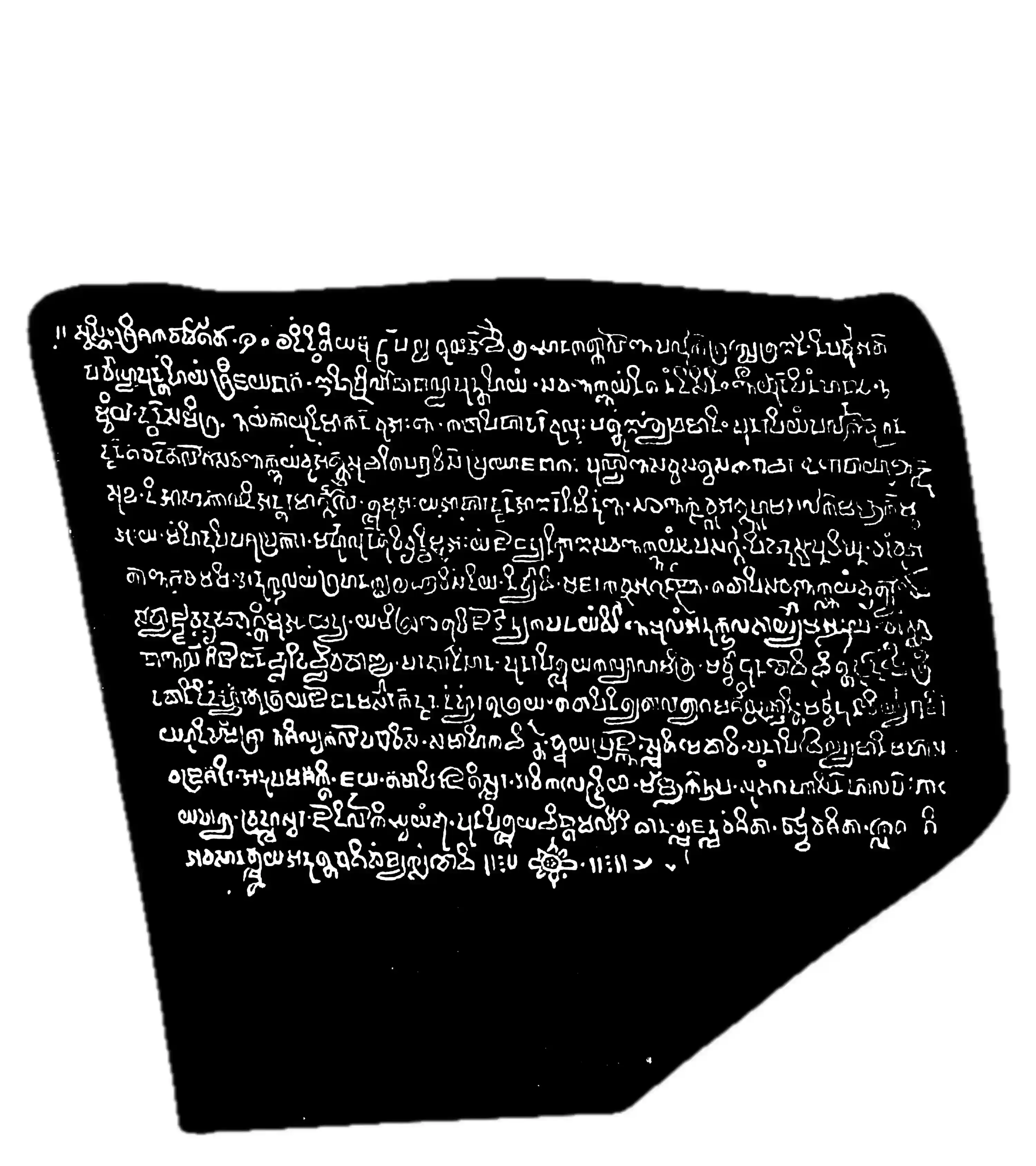
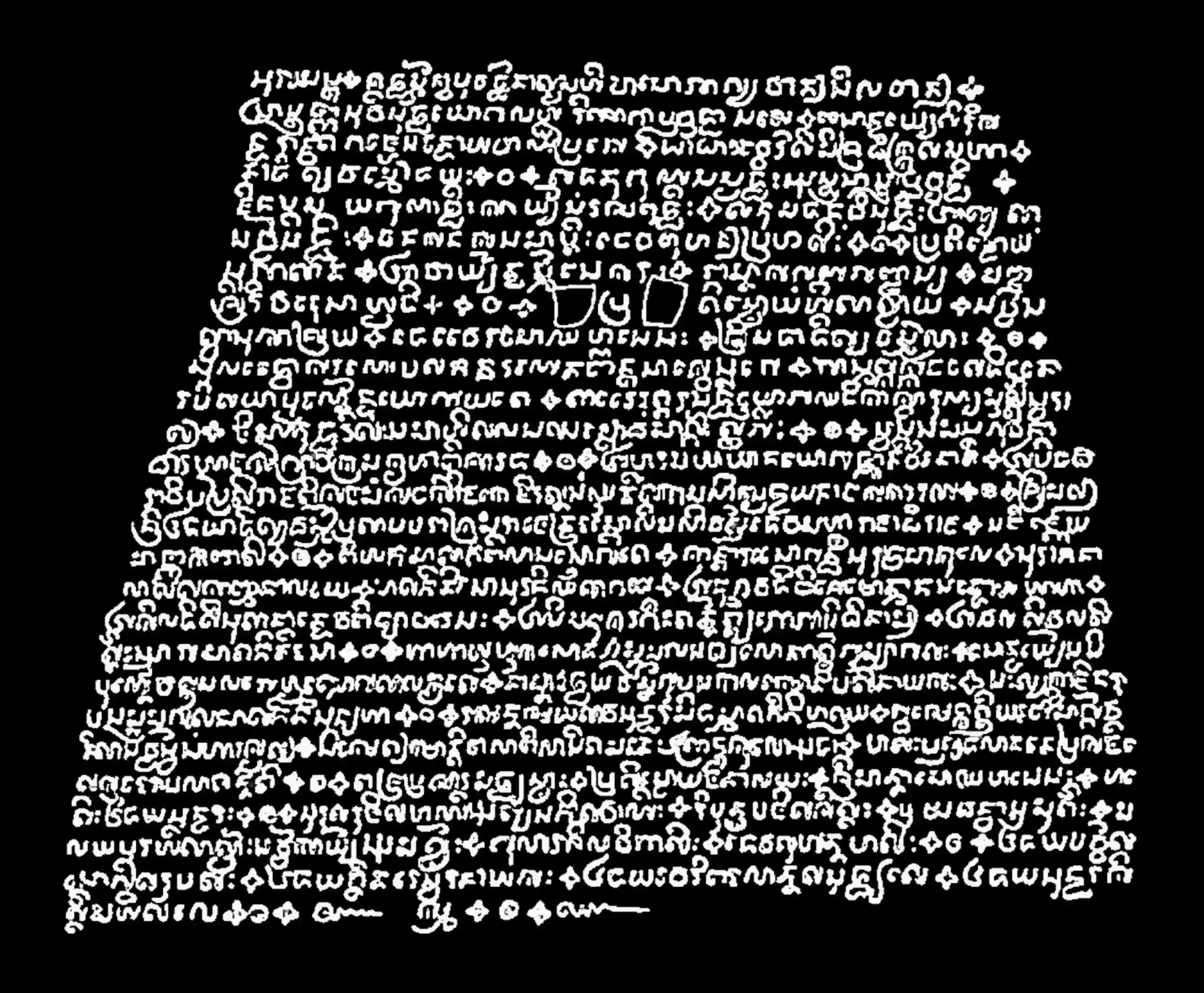
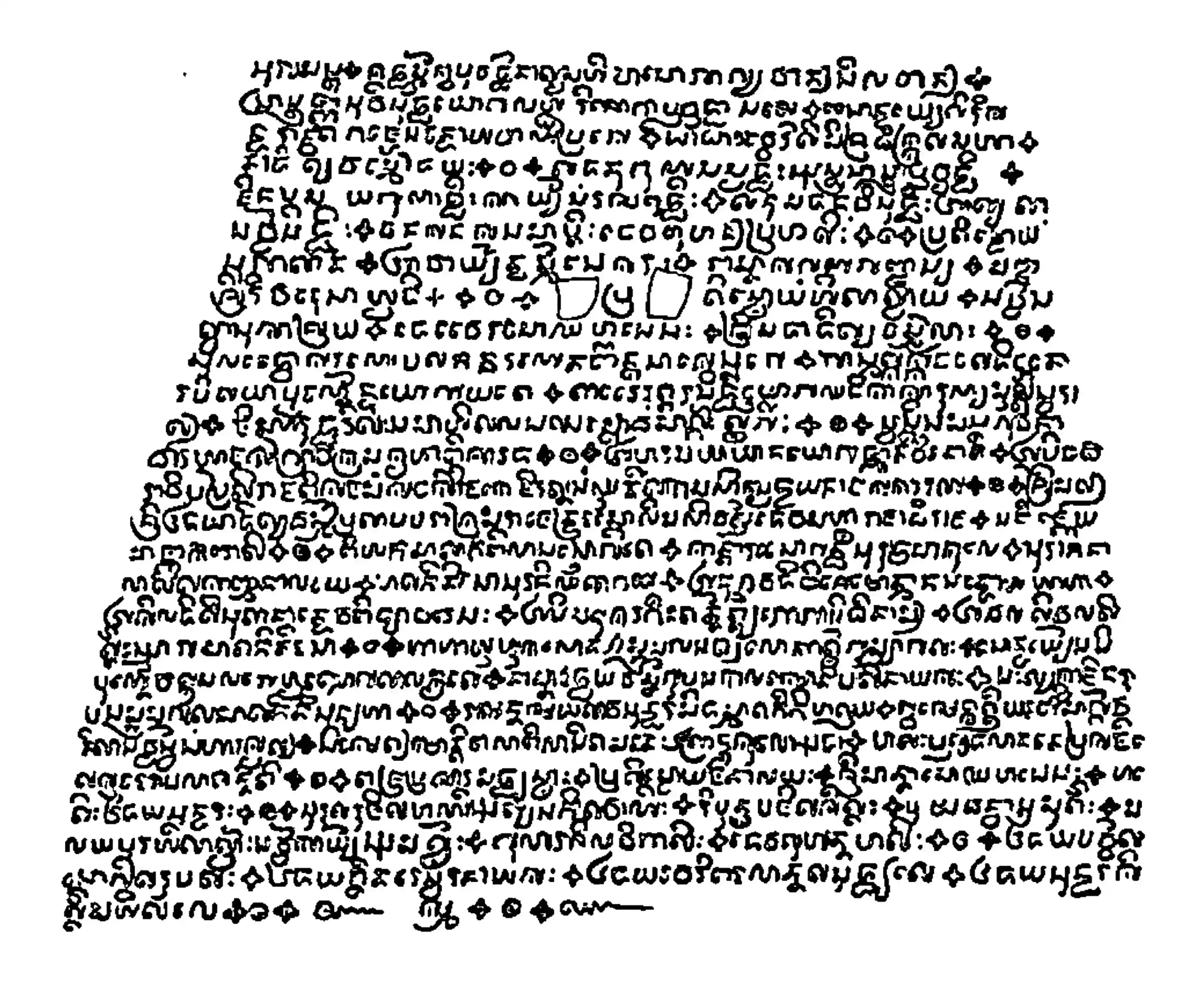
Digital enhancement of Kern’s documentation (Figure 9) exposes three concrete palaeographic transformations. First, the systematic angularisation of character forms. In Figure 9, notice character ka in line 3 of the Ādityawarman inscription: note the sharp 90-degree angles at stroke terminals, creating geometric precision suited for sandstone carving. Compare this with the same ka character in Kĕdukan Bukit (Figure 1), displaying curved terminals with gradual transitions—rounded forms characteristic of a seventh-century adaptation from South Indian models. This angularisation is not writer incompetence but material adaptation: carving angular forms in sandstone produces more durable and legible results than attempting to replicate the rounded forms suited for the granite used in South India.
Second, the development of an independent vowel-marking system. Notice in Figure 9 how the vowel diacritics are positioned and formed differently from fourteenth-century Javanese conventions—the vowel mark i (short vertical stroke above the character) consistently appears right of the character centre in Ādityawarman, whereas it tends to be more precisely centred in contemporaneous East Javanese inscriptions based on available comparative documentation. This positional distinction creates a visual marker signalling palaeographic autonomy even to viewers who cannot read the text.
Third, the creation of distinctive regional ligatures. In line 5 of Figure 9, notice the compound character combining dh and y: this ligature integrates Sanskrit syllables into a compound form that appears to have no direct precedent in either South Indian Pallava tradition or Old Javanese palaeography, representing what seems to be a novel Sumatran solution for complex Sanskrit phonology. These three innovations—angularisation, independent vowel marking, and regional ligatures—together constitute visual evidence of aesthetic autonomy. This script literally looks different from both its Indian antecedents and Javanese counterparts, creating a distinctive Sumatran visual identity.
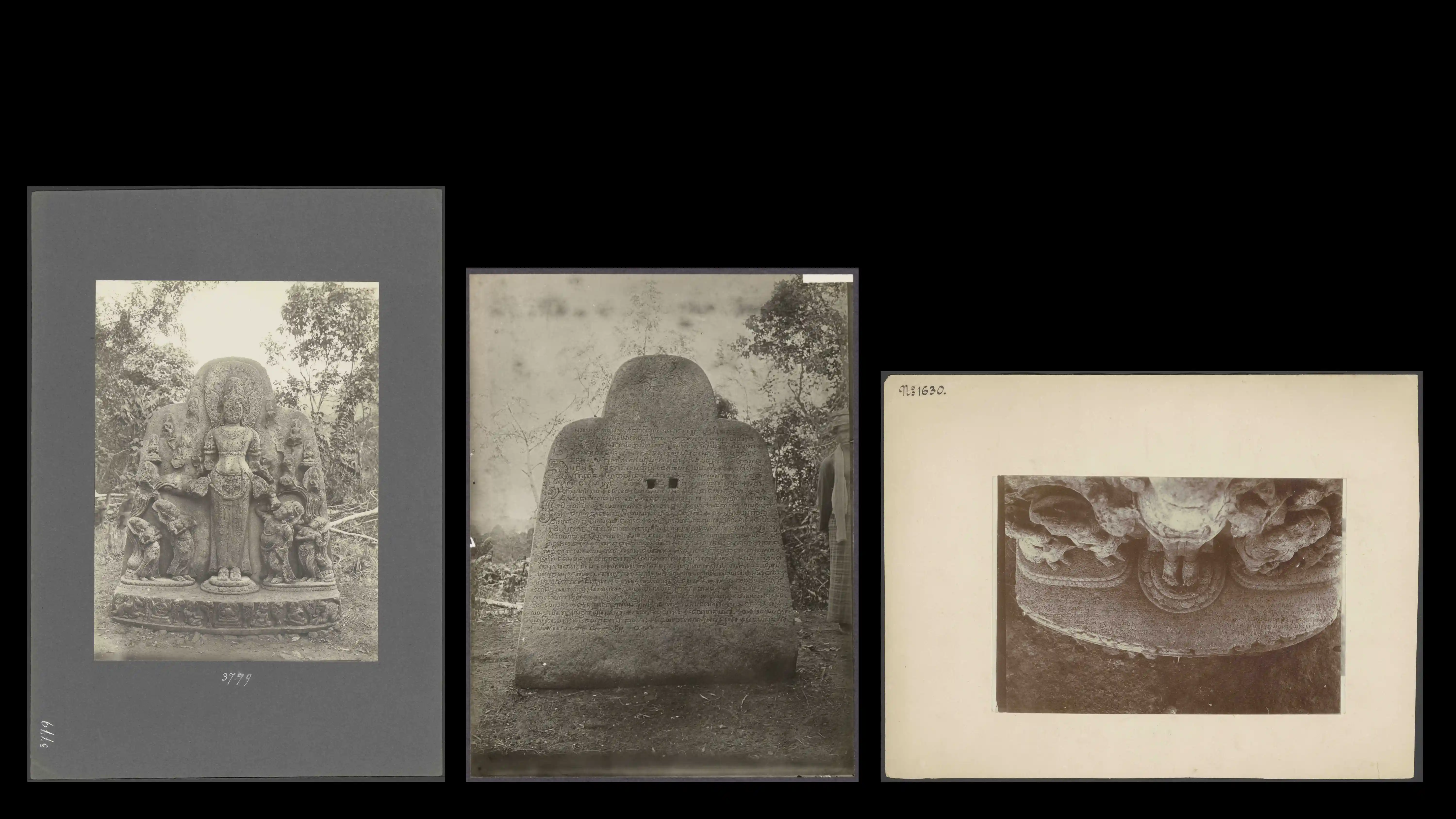
This palaeographic autonomy directly supports the political interpretation that Ādityawarman ritually declared independence from the weakening Śrīwijaya hegemony and the former Singhasari influence. As the inscription’s liturgical register asserts theological authority without requiring validation from Indian Sanskrit norms, the visual script innovations assert cultural authority without requiring validation from Old Javanese palaeographic norms. The medium becomes the message: a ruler commissioning an inscription in script that visually declares ‘we are neither Indian nor Javanese, we are Sumatran’ makes the same political claim as the text content—that the portion of West Sumatra under Ādityawarman constitutes an independent centre of religious and political authority. Where Kern saw degradation and error, we can now recognise deliberate innovation and confident assertion of cultural sovereignty. The physical evidence of these palaeographic innovations remains visible on the statue today (Figure 10).
The dramatic nature of this transformation becomes clearer when we compare the 1347 CE inscription on the statue’s back with the Dharmmāśraya inscription (1286 CE) carved around the same Amoghapāśa statue pedestal only 61 years earlier. Both inscriptions, although related to the same statue, display striking palaeographic and linguistic differences revealing a fundamental political shift. The Dharmmāśraya inscription uses character forms closer to Old Javanese conventions. Notice the characters ka, ga, and da in the 1286 CE inscription: the terminals display curves with gradual transitions, characteristic of thirteenth-century East Javanese script. The inscription language is Old Javanese-dominated with strategic Old Malay term insertions like diantuk (taken), dari (from), ka (to), mangiringkan (accompanying), and muang (and also).
The opening formula uses Old Javanese structure: swasti śakawarsātīta 1208 followed by complete dating with the Old Javanese astrological system. The main narrative is in Old Javanese: inaṅ tatkāla pāduka bhārāla āryyāmoghapāśa lokeśwara caturdaśātmika saptaratnasahita (at that time His Majesty Aryya Amoghapāśa Lokeśvara with fourteen followers and seven jewels). Old Malay use is limited to key phrases asserting a Sumatra-Java connection: diantuk dari bhūmijāwa ka swarṇṇabhūmi dipratiṣṭha di dharmmaśraya (taken from the land of Java to the land of gold, established in Dharmmāśraya). This linguistic strategy reflects bilateral diplomacy: The Old Javanese script and language indicate acknowledgement of Singhasari authority (which in 1286 CE still held strong power in East Java), while the Old Malay insertion for key concepts asserts Sumatran identity without challenging the existing regional hierarchy.
The contrast with the inscription on the back of the statue (1347 CE) is dramatic. Character forms change radically from the Old Javanese rounded terminals to distinctive Sumatran angular forms. The ka character displays sharp 90-degree angles, not gradual curves. The vowel-marking system shifts: the mark i is positioned right of the character centre, not centred as per Javanese convention. New ligatures emerge without Javanese precedent (the compound dh-y). The language shifts from Old Javanese domination to a hybrid Sanskrit-Old Malay register. The opening formula uses Sanskrit (śīlavan śāstrajña), but the syntactic structure follows Old Malay patterns. Code-switching becomes more complex and deliberate, with the inscription alternating between classical Sanskrit and hybrid registers throughout its twelve verses: verses 1–2 employ classical Sanskrit for doctrinal legitimation, verses 3–4 shift to an Old Malay-Sanskrit hybrid for the local political audience, verses 5–9 continue this hybrid pattern with varying degrees of Sanskrit influence, and verses 10–11 return to classical Sanskrit for the geographical description. Most significantly: no Old Javanese language use at all.
The theological content changes: The 1286 CE inscription mentions pāduka śrī mahārājādhirāja śrī kṛtanāgara (His Majesty Sri Maharajadhiraja Sri Krtanagara, Singhasari ruler) as the command giver, placing Dharmmāśraya within the regional hierarchy under Java. Conversely, the 1347 CE inscription mentions Ādityawarman as an avatāra of Mātaṅginīśa without reference to Javanese authority—a theological statement positioning West Sumatra as an independent centre of religious legitimation.
This transformation is not coincidental, but a deliberate political statement. In the 61 years between both inscriptions (1286–1347 CE), the Southeast Asian political landscape changed dramatically. In 1286 CE, Krtanagara still held strong power in East Java, and Dharmmāśraya operated as a junior ally in the Singhasari tributary system. The linguistic and palaeographic strategy of the 1286 CE inscription—using the Old Javanese script and language with strategic Old Malay insertions—reflects careful diplomacy: acknowledging regional hierarchy while asserting local identity. However, by 1347 CE, the political landscape had transformed: Singhasari had long since fallen (replaced by Majapahit in 1293), and Śrīwijaya had collapsed, and Ādityawarman asserted autonomy in West Sumatra. The shift to a visually different script from Javanese and to a linguistic register that no longer included the Old Javanese language represented a declaration of cultural independence.
Critical analysis of Kern’s documentation reveals a paradoxical colonial methodology: he simultaneously acknowledged the technical writing while refusing to acknowledge its intellectual legitimacy. Kern (1907) noted in detail that the inscription consisted of twelve verses in various Sanskrit metres—Śārdūlavikrīḍita, Mālinī, Anuṣṭubh, Jagatī, and Drutavilambita—all metrically perfect. For non-experts: Sanskrit poetry follows extremely strict rules about syllable patterns. The Śārdūlavikrīḍita metre, for instance, requires exactly 19 syllables arranged in a specific pattern of 12 gaṇa (metrical groups). To write twelve verses in five different metres, all metrically perfect, requires years of training in advanced Sanskrit prosody. Furthermore, Kern himself successfully translated the inscription content—about Ādityawarman as an avatāra of Mātaṅginīśa (Tantric form of Amoghapāśa), Dewa Tūhan as the Patih leading the ceremony, and the Malayapura location (Kern 1907).
If the text is metrically perfect and semantically comprehensible, how can it be categorised as babble? This paradox reveals that Kern’s critique concerned not intelligibility but conformity: this text failed not because it was incomprehensible, but because it did not conform to the Sanskrit norms Kern considered the sole legitimate standard. Crucially, the palaeographic innovations documented above provide material evidence that this nonconformity was deliberate: a writer capable of systematically creating angular characters, independent vowel markers, and novel ligatures clearly possessed advanced technical mastery. The errors Kern identified were not products of incompetence but strategic choices by writers working within the regional tradition that had developed its own norms over seven centuries.
What makes the Ādityawarman inscription revolutionary is the political and theological context in which it operates. In the mid-fourteenth century, West Sumatra under Ādityawarman declared autonomy from both Singhasari and the weakening Śrīwijaya. The inscription uses code-switching—this language mixing is not confusion but strategic multilingualism. Verses 1–2 use Sanskrit for Ādityawarman’s description (śīlavan = virtuous, śāstrajña = expert in scriptures), verses 3–4 shift to the Old Malay syntactic structure with Sanskrit vocabulary for the ritual description (pratisthoyaṃ with the Old Malay word order), and verses 10–11 revert to Sanskrit for the geographical location description (bihaṅgamātāṅgabilāsasobhite = adorned by birds and elephants). This code-switching pattern shows not inconsistency but a deliberate strategy for various audiences: Sanskrit for doctrinal legitimation (to show Buddhist theological authority), Old Malay-Sanskrit hybrid for the local political audience (to assert local identity while maintaining a connection with the broader Buddhist networks).



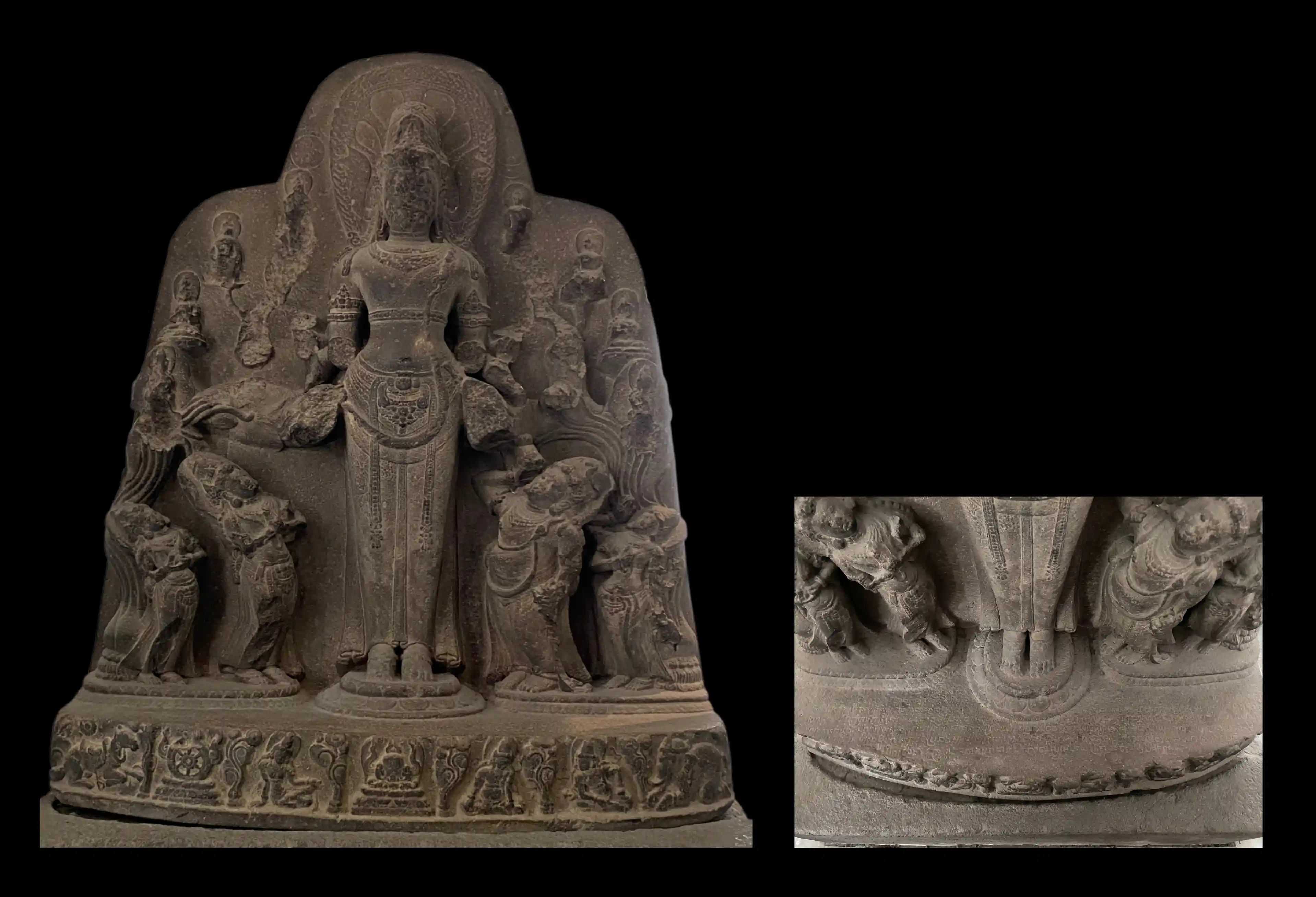
The Ādityawarman inscription represents the culmination of what Mignolo (2011) calls epistemic disobedience—the refusal to accept imported categories and standards as the inevitable truths. The seven-century trajectory shows a consistent evolution pattern: Kĕdukan Bukit (682 CE) reveals the strategic adaptation of a writing system for specific political purposes (commemorating the ritual establishment of polity through a complex theological-political narrative); Kebon Kopi II (932 CE) demonstrates cultural diplomacy through bilateral negotiation (Old Malay language plus Old Javanese candrasaṅkala); Ādityawarman (1347 CE) achieves aesthetic autonomy with the creation of a hybrid register and distinctive regional script forms, no longer requiring approval from external centres. Chronological evidence challenges diffusionist assumptions: not passive transmission from centre to periphery, but selective appropriation and creative transformation. The model emerging from this analysis repositions Southeast Asia from the passive cultural periphery to an active space of innovation—where various traditions meet, interact, and produce new syntheses that are distinctively local yet productively engaged with broader regional networks.
Glossary
- 1.
- prasasti, inscription: a text carved on stone, metal, or other durable material, typically recording important historical, religious, or political events
- 2.
- aksara, writing system, script, or alphabet used in South and Southeast Asia: refers to various indigenous scripts derived from Brāhmī, including those used to write Sanskrit, Old Malay, Old Javanese, and other languages
- 3.
- anusvāra, specific type of nasal sound and its diacritic mark in the aksara: a diacritic mark (usually a dot or small circle) placed above a character to indicate nasal pronunciation, comparable to the tilde (~) in Spanish mañana
- 4.
- estampage, rubbing: a reproduction technique where paper is placed over an inscription and rubbed with charcoal or ink to create a negative image, similar to the Japanese takuhon (拓本) technique
- 5.
- palaeography, study of ancient writing: the scholarly discipline examining the development and characteristics of historical scripts, including their forms, styles, and evolution over time
- 6.
- epigraphy, study of inscriptions: the scholarly discipline focused on deciphering and interpreting texts carved on durable materials like stone or metal
- 7.
- ligature, combined character form: two or more characters joined together to form a single compound glyph, similar to the way Japanese kana sometimes combines elements
- 8.
- diacritic, additional mark: a symbol added to a letter to modify its pronunciation or meaning, such as the vowel marks in the Arabic script or the dakuten (゛) in Japanese
- 9.
- phoneme, distinctive sound unit: the smallest unit of sound in a language that can distinguish meaning, for example /p/ and /b/ in pat and bat, respectively
- 10.
- velar nasal, ng-sound: a nasal consonant produced at the soft palate, represented by ng in English sing or Malay datang, similar to the /n/ sound in Japanese manga (漫画) when pronounced before /g/ as [ŋ]
- 11.
- bilabial nasal, m-sound: a nasal consonant produced by closing both lips, represented by m in English member or Malay minum
- 12.
- phonological, relating to sound systems: concerning the systematic organisation of sounds in a language
- 13.
- syntactic structure, sentence organisation: the grammatical arrangement of words and phrases to create well-formed sentences
- 14.
- code-switching, language mixing: the practice of alternating between two or more languages or language varieties within a single conversation or text, common in multilingual societies
- 15.
- siddhayātra, magical journey: a Sanskrit term meaning a journey undertaken to obtain supernatural power or spiritual perfection
- 16.
- pranidhāna, Buddhist vow: a solemn commitment or aspiration in Buddhist practice, often associated with the bodhisattva dedication to enlightenment
- 17.
- Mahāyāna, Great Vehicle Buddhism: one of the major branches of Buddhism emphasising the bodhisattva path and universal salvation, prevalent in East and Southeast Asia
- 18.
- vajraśarīra, vajra body: in Tantric Buddhism, an indestructible or diamond-like spiritual body representing the ultimate reality
- 19.
- anuttarābhisamyaksambodhi, highest perfect enlightenment: the supreme and complete awakening attained by a Buddha
- 20.
- Amoghapāśa, Unfailing Noose: a form of the bodhisattva Avalokiteśvara in Mahāyāna Buddhism, associated with compassion and rescue from suffering
- 21.
- avatāra, divine incarnation: a manifestation or embodiment of a deity in earthly form, similar to the Japanese concept of gongen (権現)
- 22.
- Tantric, relating to Tantra: concerning esoteric Buddhist or Hindu practices involving ritual, visualisation, and transformation
- 23.
- wanua, polity or settlement: an Old Malay term for a political unit, territory, or settled area, comparable to the Japanese kuni (国)
- 24.
- candrasaṅkala, chronogram: an Old Javanese dating system in which numbers are encoded through words with numerical meanings, similar to some Japanese dating conventions using reign names
- 25.
- Śārdūlavikrīḍita, tiger-sport metre: a complex Sanskrit poetic metre that requires exactly 19 syllables per line in a specific pattern
- 26.
- Mālinī, garland metre: a Sanskrit poetic metre with 15 syllables per line
- 27.
- Anuṣṭubh, standard metre: the most common Sanskrit verse form with 8 syllables per quarter, used extensively in epic poetry
- 28.
- Jagatī, world metre: a Sanskrit poetic metre with 12 syllables per quarter
- 29.
- Drutavilambita, quick-slow metre: a Sanskrit poetic metre combining rapid and slow rhythmic patterns
- 30.
- gaṇa, metrical group: a unit of metrical pattern in Sanskrit prosody, consisting of three syllables in various combinations of long and short
- 31.
- status quo ante, previous state: a Latin phrase meaning the situation as it was before, used to describe restoration to a former condition
- 32.
- angularisation, geometric transformation: the process of changing script forms from curved to angular shapes, often associated with adaptation to different writing materials
- 33.
- orthographic conventions, spelling rules: the standardised system for writing a language, including letter use, punctuation, and formatting
- 34.
- Tang Dynasty, Chinese imperial period: the Chinese dynasty that ruled from 618 to 907 CE, during which extensive records of Southeast Asian kingdoms were maintained
- 35.
- bodhisattva, enlightened being: in Mahāyāna Buddhism, a person who has attained enlightenment but postpones final nirvana to help others achieve liberation
References
- Benjamin, W.
- 1969
- Illuminations: Essays and Reflections. New York: Schocken Books.
- Boechari
- 1979
- An Old Malay Inscription of Srivijaya at Palas Pasemah (South Lampung). In Satyawati Suleiman et al. (eds.) Pra Seminar Penelitian Sriwijaya, Jakarta, 7–8 Desember 1978, pp. 19–40. Jakarta: Proyek Penelitian dan Penggalian Purbakala Departemen Pendidikan & Kebudayaan.
- 1986
- New Investigation on the Kedukan Bukit Inscription. In Untuk Bapak Guru: Persembahan para murid untuk memperingati usia genap 80 tahun Prof. Dr. A. J. Bernet Kempers. pp. 33–56. Jakarta: Pusat Penelitian Arkeologi Nasional.
- Bosch, F. D. K.
- 1941
- Een Maleische inscriptie in het Buitenzorgsche. Bijdragen tot de Taal-, Land- en Volkenkunde van Nederlandsch-Indië 100: 49–53.
- Cœdès, G.
- 1930
- Les inscriptions malaises de Çrīvijaya. Bulletin de l’École française d’Extrême-Orient 30: 29–80.
- de Casparis, J. G.
- 1956
- Prasasti Indonesia II: Selected Inscriptions from the 7th to the 9th Century A.D. Bandung: Masa Baru.
- Djafar, H.
- 2014
- Invansi Śriwijaya ke Bhūmijāwa: Pengaruh Agama Buddha Mahayana dan Gaya Seni Nalanda di Kompleks Percandian Batujaya. Kalpataru, 23(2): 121–136.
- Kern, H.
- 1907
- De wij-inscriptie op het Amoghapāça-beeld van Padang Candi (Batang Hari-districten); 1269 Çaka. Tijdschrift voor Indische Taal-, Land- en Volkenkunde 49: 159–170.
- Mignolo, W. D.
- 2011
- The Darker Side of Western Modernity: Global Futures, Decolonial Options. Durham: Duke University Press.
- Moens, J. L.
- 1937
- ‘Çrivijaya, Yava en Kataha’. Tijdschrift voor Indische Taal-, Land- en Volkenkunde 77: 318–327.
- Muljana, S.
- 2006
- Sriwijaya. Yogyakarta: LKiS.
- Poerbatjaraka, R. M. Ng.
- 1952
- Riwajat Indonesia, Djilid I. Jakarta: Jajasan Pembangunan.
- Quijano, A.
- 2000
- Coloniality of Power and Eurocentrism in Latin America. International Sociology 15(2): 215–232.
- Stoler, A. L.
- 2009
- Along the Archival Grain: Epistemic Anxieties and Colonial Common Sense. Princeton: Princeton University Press.
- Susanti, N., T. Pudjiastuti and Trigangga (eds.)
- 2015
- Inscribing Identity: The Development of Indonesian Writing Systems. Jakarta: National Museum of Indonesia.
- Vogel, J. Ph.
- 1925
- The Earliest Sanskrit Inscriptions of Java. Publicaties van den Oudheidkundigen Dienst in Nederlandsch-Indië, Deel I. pp. 15–35. Batavia: Albrecht & Co.
- Wolters, O. W.
- 1967
- Early Indonesian Commerce: A Study of the Origins of Śrīvijaya. Ithaca: Cornell University Press.
Contact
Sinta Ridwan
*Replace “■” with “@”.
Agus Aris Munandar
*Replace “■” with “@”.
Manneke Budiman
*Replace “■” with “@”.